
Why HR Is Becoming a Critical Growth Lever for UAE Businesses
In the UAE, business conditions do not move in a straight line.
Periods of expansion are often followed by moments that require tighter control, sharper prioritization, and more disciplined execution. For founders and early-stage business owners, the challenge is not simply to grow when conditions are favorable, but to maintain stability when they are not—and to be ready to accelerate again when momentum returns.
At the start, most businesses focus on what matters: customers, revenue, and getting the operation off the ground. People management is handled in the background, directly by the founder or a small leadership team.
That works—initially.
But as the business grows, what was once manageable becomes a constraint. What worked at 5 or 10 employees rarely works at 20 or 30.
This is where pressure begins to show.
Not because opportunity disappears, but because the internal structure has not kept pace with growth.
At this point, HR becomes critical.
Not as administration—but as the system that allows a founder-led business to stay in control while it scales.
When Growth Outpaces the Founder Model
In the early stages, businesses run on proximity.
The founder is involved in hiring.
Decisions are made quickly.
Communication is direct.
Expectations are often implicit rather than defined.
This creates speed and alignment.
But as the business grows, the distance increases. The founder cannot be involved in every decision. Managers begin to take ownership. Teams expand beyond direct oversight.
This is where informal systems begin to break.
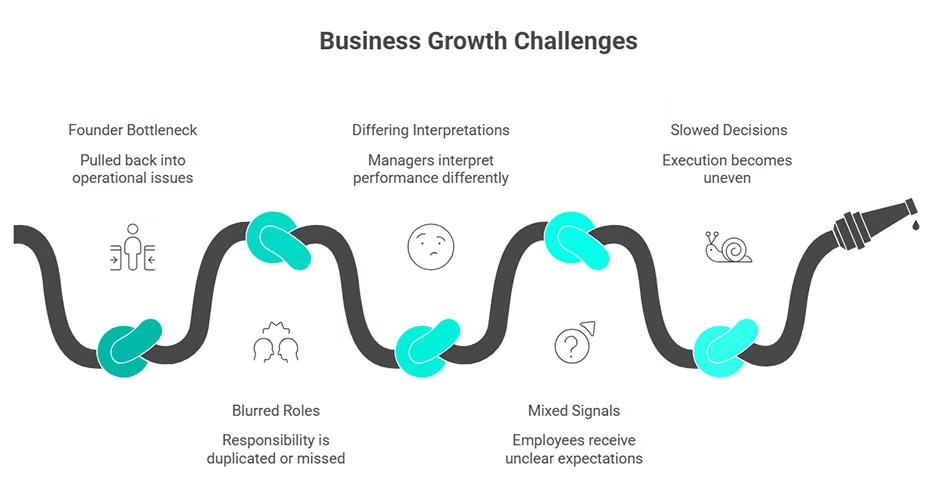
Roles become blurred. Two people may take responsibility for the same outcome, while other areas are left uncovered. Managers interpret performance differently. Employees receive mixed signals on what is expected of them.
At the same time, the founder becomes a bottleneck—pulled back into operational issues that should sit within the business.
The shift is gradual, but the impact is real.
Decisions slow down.
Execution becomes uneven.
Time is lost managing issues instead of driving growth.
This is not a hiring problem.
It is a structural problem.
HR as the System That Replaces Founder Dependency
For early-stage businesses, HR is often seen as something to “add later.”
In reality, it is what allows the business to move beyond dependence on the founder.
HR defines how the business runs when the founder is not directly involved in every decision. It creates the rules, processes, and standards that allow managers to operate consistently and employees to perform with clarity.
It determines:
- How people are hired
- What good performance looks like
- How decisions are made and escalated
- How issues are resolved
When these elements are clear, the business becomes less dependent on individuals and more reliant on structure.
Without them, performance depends on proximity to the founder.
This is the inflection point for most UAE SMEs.
Either the business builds structure—or it becomes increasingly difficult to scale.
Why This Matters More in the UAE
In many markets, informal systems can operate for longer periods without consequence. In the UAE, the margin for error is smaller.
Employment contracts, documentation standards, visa processes, and systems such as WPS are not optional. They are part of how the business must operate.
In the early stages, these requirements are often handled reactively. Contracts are created as needed. Documentation is stored inconsistently. Processes are not standardized.
This works—until it doesn’t.
As the business grows, small inconsistencies create friction:
- Contracts that do not reflect actual working terms
- Documentation that is incomplete or difficult to access
- Decisions that are delayed because the correct structure is unclear
These are not major failures. But they slow the business down at exactly the point where speed matters.
HR, when structured correctly, removes this friction by embedding compliance into how the business operates—rather than treating it as an afterthought.
Why Structure Matters When Pressure Increases
When conditions tighten, founders naturally focus on cost, cash flow, and efficiency.
But efficiency is not just financial. It is operational.
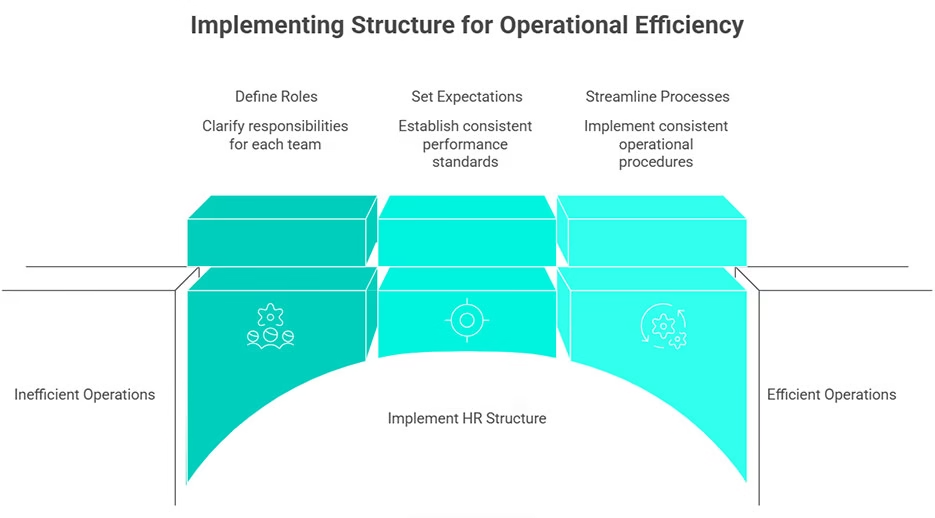
A business with clear roles, defined expectations, and consistent processes can operate with discipline. Managers make decisions faster. Teams work more effectively. Leadership can focus on growth rather than internal issues.
Without that structure, pressure exposes inefficiencies.
Time is spent resolving avoidable issues. Decisions are delayed because ownership is unclear. Managers apply different standards, creating inconsistency across the business.
In practical terms, structured HR allows founders to:
- Reduce wasted time across the business
- Improve consistency in how teams perform
- Make decisions with greater clarity and speed
- Focus on commercial priorities rather than internal friction
This is where HR moves from “nice to have” to essential.
Positioning for the Next Phase of Growth
For early-stage businesses, the most important question is not how to manage today—but how to prepare for what comes next.
Because when conditions improve, growth returns quickly.
Businesses with a structure in place can respond immediately. They hire with clarity. They onboard effectively. They scale teams without losing control.
Those who do not face a different reality.
Growth creates pressure. Hiring becomes reactive. Managers struggle to maintain consistency. The business expands—but with increasing friction.
This is where many SMEs stall.
Not because they lack opportunity—but because they are not set up to execute at the next level.
HR, when implemented early, ensures that growth does not break the business.
It creates readiness.
The Founder Constraint: Capability Without Fixed Cost
For founders, the challenge is not understanding the need for HR. It is justifying the investment.
Hiring a full-time HR manager can feel premature. At the same time, doing nothing creates risk.
A mid-level HR hire can cost AED 15–20K a month, without covering everything.
And more importantly, one person does not solve the structural problem.
Because HR is not a role.
It is a system.
What founders need is not another headcount.
They need a way to implement structure without increasing fixed costs.
A More Effective Model: Build the System, Then Scale It
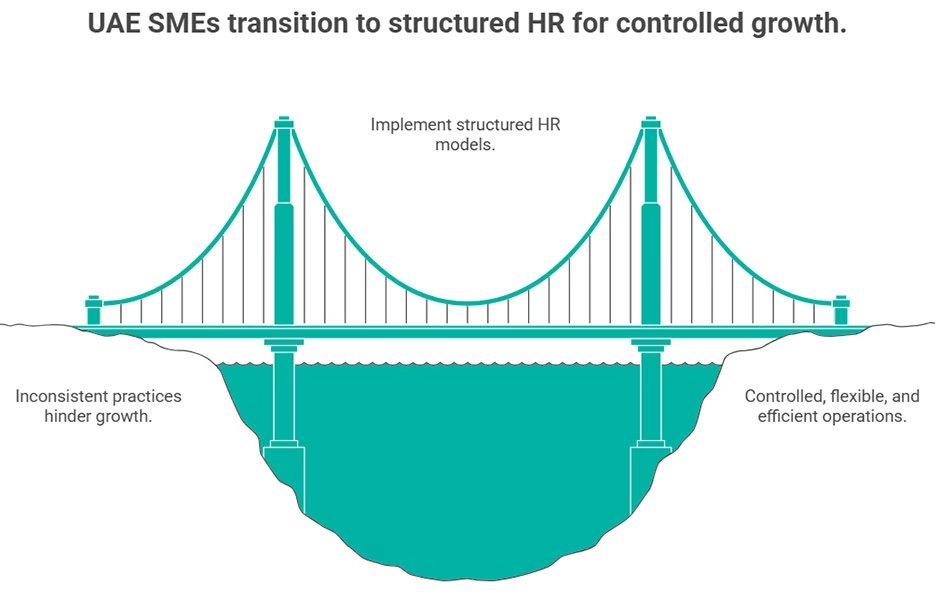
This is why more UAE start-ups and early-stage SMEs are adopting structured, externally supported HR models.
The objective is not to outsource responsibility—but to establish a working system from the outset.
This means:
- Contracts and documentation are aligned from day one
- Hiring follows a consistent framework
- Performance is managed through defined expectations
- Employee decisions are handled through clear processes
On top of this, founders access experienced support when needed—during key decisions, not continuously.
This creates a model that is both controlled and flexible.
The business operates with structure, without carrying unnecessary overhead.
Technology as a Force Multiplier
For early-stage businesses, technology plays a critical role in maintaining control without adding complexity.
HR systems allow founders to centralize employee information, track key processes, and maintain visibility as the team grows.
Instead of relying on memory, spreadsheets, or individual managers, the business operates from a single source of truth.
This becomes increasingly important as headcount grows.
Because scale does not break systems—it exposes whether they exist.
From Informal to Scalable Operations
At its core, the shift is operational.
In the early stages, businesses run on informal management. Decisions depend on individuals, and outcomes vary accordingly. This works while the founder is close to every part of the business.
As the business grows, that model becomes harder to sustain.
Structure replaces dependency. Processes replace interpretation. The business moves from being managed through people to being managed through a system.
This does not slow the business down. It allows it to move faster—with consistency.
Under pressure, the business remains controlled.
As conditions improve, it scales without friction.
Growth becomes an extension of how the business already operates—not a disruption to it.
Conclusion
In the UAE, opportunity is not the constraint. Execution is.
For founders, the difference becomes clear over time. Businesses that scale effectively are not just the ones that move fast—they are the ones that build structure early.
HR sits at the center of that structure.
Not as administration, but as the system that allows the business to operate without constant founder intervention, to manage risk without slowing down, and to scale without losing control.
The question is not whether HR is needed.
It is time to build it properly.
For many start-ups and early-stage SMEs, the most effective path is not to build internally but to implement the right structure from the outset—supported in a way that matches the business’s stage.
That is where partners like EZONE come in.
FAQ’s