Dubai Property Market 2026: What 2025’s Record Growth Means for Buyers, Renters & Investors
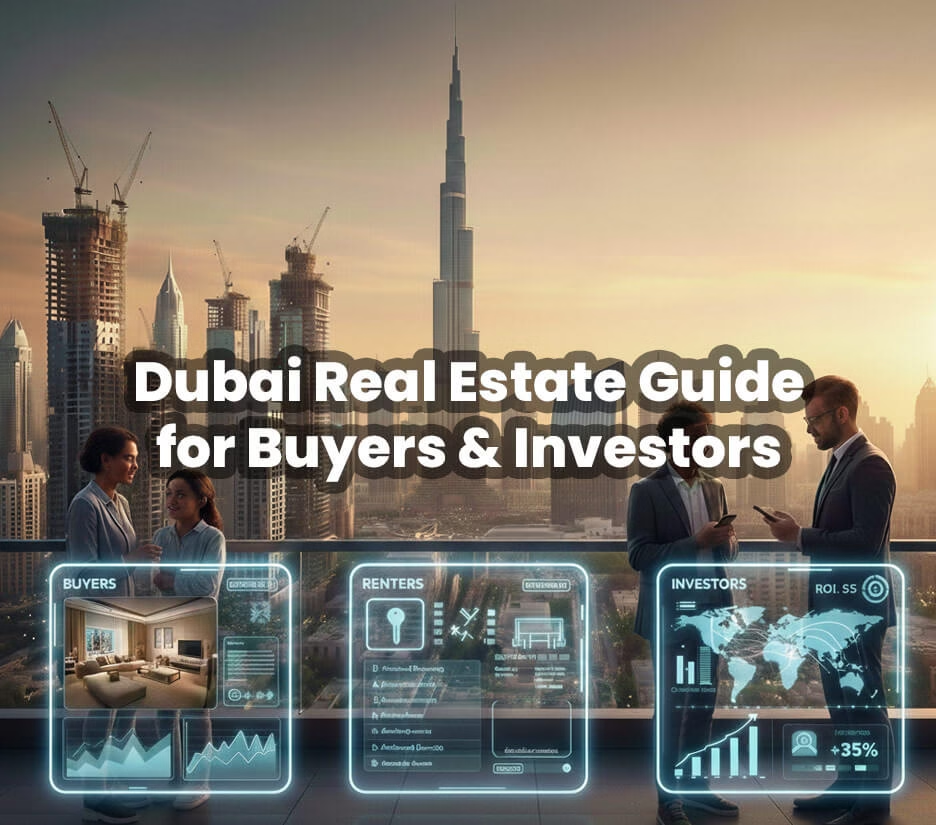
Table of Contents
TL;DR (Quick Summary)
- Dubai closed 2025 at record highs with AED 682.5B in sales and 214,912 transactions.
- The market is shifting into a more mature, selective phase, with buyers doing more due diligence and negotiating more.
- High supply deliveries in 2026 could lead to price softness in some segments, especially oversupplied mid-market areas.
- Infrastructure upgrades and tech-driven economic growth should keep high-demand communities resilient.
- Property-linked residency remains a major pull through the AED 750k investor visa and AED 2M Golden Visa route.
Dubai Real Estate Market 2026
Dubai ended 2025 with one of the strongest real estate performances in its history, recording AED 682.5 billion in total sales and 214,912 transactions. As the market shifts into a more selective phase in 2026, buyers and investors are also paying closer attention to long-term residency options that can come with property ownership.
That alone is impressive. But the bigger story is what those numbers reveal.
Dubai is no longer in the “fast rebound” era after the pandemic. It is entering a phase of mature growth. Demand is broad. The buyer base is deeper. Population growth is real. And the market is now segmented enough that 2026 won’t move as one.
That’s why 2026 won’t simply be about ‘prices going up.’
A) Dubai Property Market 2025 in Numbers
If you only read one section, read this. Because 2025 was not just a “good year.” It was a landmark year. Dubai’s real estate market in 2025 recorded:
- AED 682.5 billion in total sales
- 214,912 transactions
- A year-on-year increase of 30%+ in value and nearly 19% in volume
This is important. Because growth in transaction volume tells us demand was widespread. It wasn’t only a handful of luxury buyers inflating the market.
It also aligns with a broader pattern: Dubai has now delivered multiple consecutive years of strong performance, with major reports describing 2025 as the market’s fifth year of exceptional growth.
What this tells us about the market
Dubai’s property story is no longer purely speculative.
Yes, investors still play a big role. But the market is now driven by a wider mix, with long-term residents, entrepreneurs, skilled professionals, families and global buyers who are using Dubai as a base, not just a flip. That makes 2026 a very different environment than the boom cycles of the past.
Related Articles:
B) Why Dubai Real Estate Grew So Fast in 2025
Dubai’s 2025 growth wasn’t random. It was powered by several strong drivers working together.
1) Population growth is now one of the biggest demand engines
Dubai’s population growth has become impossible to ignore.
Dubai Statistics Center provides ongoing official population updates, which reflect the emirate’s continued growth and rising resident base.
News reporting also highlighted that Dubai added over 17,000 residents in just 30 days in November 2025, with the population crossing the 4 million mark in that period.
This matters for real estate because population growth doesn’t just increase demand in one category. It increases demand across:
- Family housing
- Rental apartments
- Premium residential towers
- Suburban villa communities
- And even commercial property through business expansion.
2) Dubai’s demand is increasingly end-user driven
Dubai still attracts investors. But a growing share of demand comes from people living and working in the city.
That shift typically leads to a more stable market over time.
Because residents buy for:
- Lifestyle
- Long-term security
- Family planning
- Not short-term profit.
3) Dubai’s property market is now multiple markets, not one market
Dubai doesn’t move like a single property market.
It moves like several markets at once:
- Ultra-prime segment
- Prime segment
- Upper mid-market
- Mid-market
- Affordability-driven segment
- Off-plan ecosystem
That segmentation becomes even more important in 2026 because the performance gap between segments will widen.
C) Dubai Property Market 2026: The Big Themes
The best way to understand 2026 is to think of it as a “sorting year.” Not everything will rise equally. Some communities will outperform. Others will stabilize. A few might soften due to supply. Here are the themes that will shape the year.
1) Dubai 2026: A Shift Toward Smarter, Selective Buying
One of the strongest signals from market commentary is that Dubai heads into 2026 in a more selective phase, with less rush-buying and more due diligence. That doesn’t mean demand disappears. It means buyers now ask tougher questions:
- Is this unit overpriced?
- What will supply look like in 12–24 months?
- How liquid is this community for resale?
- Will rental demand hold here?
- What is my exit plan?
This type of market behaviour is typically what happens when property markets mature.
2) Will 2026 Housing Supply Soften Dubai Prices?
One of the biggest conversation points for 2026 is supply. Global agencies have cautioned that Dubai could see price softness driven by large housing delivery volumes.
For example, Fitch has projected that a significant supply pipeline could drive a double-digit price decline in some segments, citing up to 210,000 units projected to be delivered and the market’s strong run since 2022.
This doesn’t mean “Dubai prices will crash.”
It means Dubai will become a market where community selection and pricing discipline matter. In practical terms:
- Some mid-market and oversupplied areas could see softer price growth or more negotiation.
- Strong, infrastructure-backed areas with real end-user demand could remain resilient.
In other words, 2026 becomes a year where buyers cannot rely on the market to “do the work for them.”
3) Infrastructure: The Hidden Driver of Dubai Property Growth
Infrastructure is one of the strongest predictors of long-term demand. When transport improves, communities that were “too far” suddenly become more attractive and prices often follow.
By 2026, Dubai’s infrastructure-driven growth will become even more visible across:
- Road expansions
- Transport connectivity
- Master-planned hubs
This aligns with a wider narrative that transport, energy, and tech are reshaping property demand across the UAE, including Dubai.
4) Tech & AI Expansion Fuelling Dubai’s Property Demand
Dubai continues to position itself as a global tech and investment destination, with major AI and innovation infrastructure and initiatives shaping economic growth.
As the economy strengthens through tech expansion, demand grows in:
- Executive housing
- Family communities
- Prime apartments near commercial hubs
- High-quality rental stock
This matters because real estate markets that are tied to expanding economic activity tend to be more resilient than markets driven only by speculative buying.
D) How UAE Property Visas Fit Into Dubai’s 2026 Market
Dubai’s real estate boom isn’t only attracting investors. It is also attracting long-term residents. For many buyers, property ownership is becoming part of a bigger plan, building stability in the UAE.
In Dubai, one of the main routes is the two-year renewable property investor visa, which applies to property owners who bought a property worth AED 750,000 or more at the time of purchase.
For those investing at a higher level, there is also the UAE’s 10-year Golden Visa route, which is commonly linked to property ownership of AED 2 million or more.
You might be interested in reading more about UAE Property Visas: Options, Costs, and Requirements.
E) What Buyers Should Expect in 2026
If you’re buying a home in Dubai in 2026, whether for living or as an asset, your advantage is that the market is no longer purely speed-driven. Here’s what buyers can realistically expect.
1) More negotiation power (in the right segments)
In a calmer market phase, some sellers become more flexible, especially where:
- Supply is rising
- Multiple similar listings exist
- Or the community is still proving its long-term value.
This doesn’t mean discounts everywhere. It means buyers must shop smarter, and community selection becomes a major advantage.
2) Stronger scrutiny on developers and delivery
Buyers are increasingly choosing projects based on:
- Delivery track record
- Long-term master plan
- Resale liquidity
- Quality of build
This is why 2026 becomes a year where credibility matters as much as branding.
3) Mortgage access and digital financing are improving
In a sign of how the market is evolving, Dubai has seen innovation in mortgage processing, including fully digital home-loan platforms that streamline comparing and applying across lenders.
While financing still depends on personal eligibility, the trend supports a market that is shifting towards more accessible and efficient buyer journeys.
F) What Renters Should Expect in 2026
Renting in Dubai has been one of the most challenging parts of the market over recent years, particularly for families and mid-income professionals.
In 2026, renters should expect:
1) Continued rental strength in high-demand, high-livability communities
Rent demand remains high in areas where people want to actually live long-term. These typically include:
- Communities with strong schools
- Commute-friendly access
- Established retail and lifestyle infrastructure
- Good building quality
2) Some stabilization where new supply enters the market
If delivery volumes rise in specific clusters, renters may see more options and less extreme rent spikes.
But this will vary by area.
Some parts of Dubai will remain pressure zones simply because demand is still far stronger than the availability of quality rental stock.
You might be interested in reading more about Renting Office Space in Dubai.
G) What Investors Should Do in 2026
Dubai remains one of the most attractive global property markets because:
- It is tax-efficient,
- Globally connected,
- Supported by population growth,
- And continues to attract international capital.
But investment in 2026 requires a more strategic lens.
1) Prioritize “demand-backed” communities
In a market where supply could soften certain segments, investor success depends on choosing areas with:
- Proven rental demand
- Real end-user migration
- Long-term community desirability
2) Avoid relying only on headline yields
High yields can look attractive on paper, but investors should assess:
- Vacancy risk
- Supply pipeline
- Building quality
- Maintenance costs
- Tenant profile
- Resale liquidity
A slightly lower yield in a high-demand community often outperforms a high-yield unit in an oversupplied zone.
3) Off-plan still works, but only with discipline
Off-plan investment remains strong, but 2026 investors must evaluate:
- Handover timelines
- Project phase maturity
- Developer credibility
- Resale conditions
In a “selective” market, off-plan flips become less predictable, and a long-term holding strategy becomes more important.
Did you know RAK ICC Foundations can now hold Dubai property?
H) What 2025’s Record Growth Really Means for 2026
Dubai ended 2025 at record highs: AED 682.5B in sales across 214,912 transactions. But 2026 won’t be defined by record-breaking numbers alone. It will be defined by:
- Selective buying,
- More supply awareness,
- Deeper segmentation,
- And smarter decision-making from both residents and investors.
For buyers, it’s a year where strategy beats speed.
For renters, it’s a year to watch supply and explore negotiation opportunities.
For investors, it’s a year to focus on fundamentals and resilience.
In Conclusion
Dubai’s record-breaking 2025 performance has set the tone for a more mature and strategic market in 2026, where success will come from choosing the right communities, the right timing, and the right setup for your goals.
EZONE, trusted business setup consultants in Dubai, assists clients through the full process of securing a UAE property visa, ensuring the purchase aligns with visa requirements, documentation is handled correctly, and residency approval is completed smoothly — because the best investment isn’t only the property, i’’s the stability it gives you.
FAQs About the Dubai Property Market
Some segments may see softness due to supply. Fitch Ratings has projected that Dubai could face a double-digit price decline in late 2025 and into 2026, driven by record housing supply expectations. However, prime areas may remain more resilient due to limited supply and continued demand.
Dubai remains attractive due to high demand, population growth, and global capital inflows.But investors in 2026 should be more selective, focusing on fundamentals like community demand, supply pipeline, and resale liquidity.
The biggest drivers will be a continued population growth, economic expansion, infrastructure upgrades and Dubai’s role as a global business hub.
It depends on the community. High-demand areas may remain expensive. But increased supply may stabilize rents in some segments. Also, the reported shift toward monthly rental payments could influence tenant behaviour and rental market structure.
If you’re buying for long-term living, the best time is usually when you find the right asset at the right price. If you’re investing, waiting can make sense if you want to see how supply enters the market, especially in communities with heavy upcoming deliveries.

EZONE specialize in creating content that highlights business setup and consultancy services. We provide expert insights on company formation, licensing, and the latest industry developments. Through this blog, we aim to equip entrepreneurs and businesses with the knowledge they need to navigate opportunities and challenges in today's market.