Dubai Startups vs Franchises: Smart Business Choices
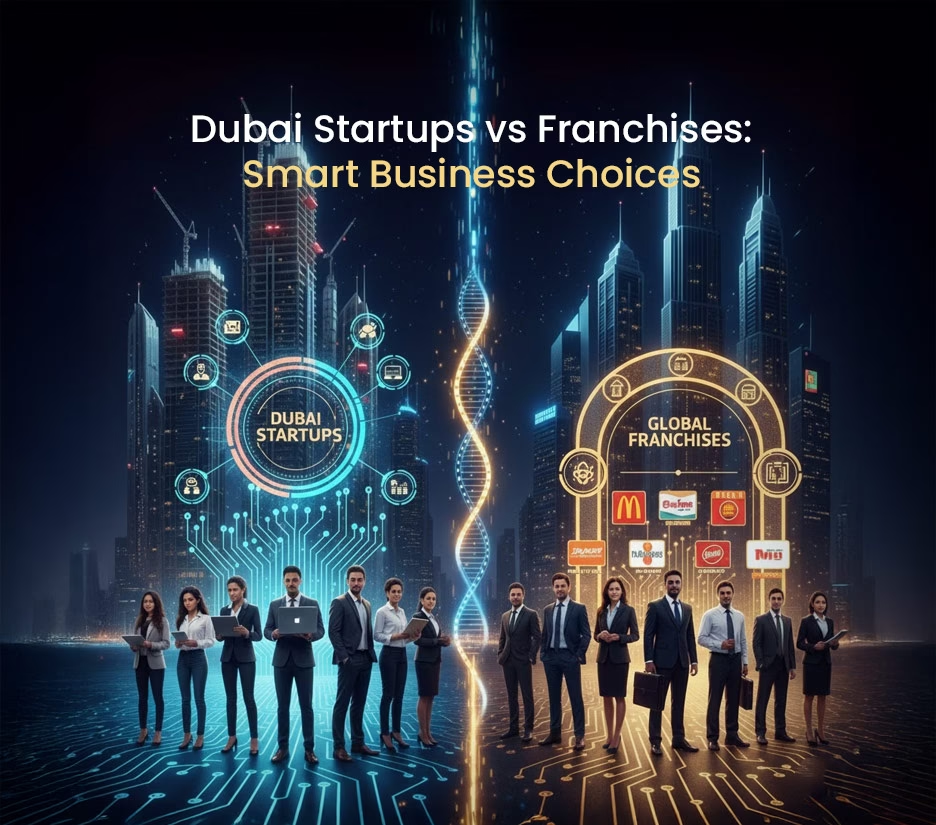
Discover whether a startup or a franchise is the smarter business model in Dubai. Compare costs, risks, growth potential, and market opportunities.
Entrepreneurs entering the UAE market often face one defining choice of either starting a business from scratch or investing in a franchise. The question is more relevant today than ever, as the city’s economy matures and attracts a new generation of founders, investors, and global brands.
Both paths are thriving in Dubai’s fast-evolving economy, where innovation meets structure, and new ventures are built on ambition. The question isn’t which is “better”, but which is right for your goals, budget, and appetite for risk.
1. Dubai: The Region’s Most Entrepreneurial City
Dubai’s business environment has transformed dramatically over the past five years. What was once a hub for trade and logistics has become a global magnet for entrepreneurs, startups, and investors. Here’s what defines the opportunity today:
- 100% foreign ownership: Since the Commercial Companies Law reform, foreign investors can fully own their business without a local sponsor for most activities.
- Digital setup and licensing: From business registration to visa issuance, most processes are now fully online through platforms like Invest in Dubai and DED Trader.
- Corporate tax clarity: The 9% corporate tax rate on profits above AED 375,000 offers predictability, while Free Zones still grant 0% tax for qualifying entities.
- A thriving startup ecosystem: Initiatives like The Entrepreneurial Nation 2.0 and Dubai Future District Fund actively fund and accelerate local startups.
- Franchise-friendly market: The UAE ranks among the top 10 global markets for franchising, with over 600 international brands operating successfully across F&B, retail, education, and wellness.
Dubai’s government isn’t just encouraging business, it’s engineering an environment built for scale. And that makes the startup vs franchise debate more nuanced than ever.
2. Understanding the Two Business Models
Before deciding which route to take, it’s important to understand how these models differ not just in concept, but in how they function within Dubai’s ecosystem.
A. Startups: Building from the Ground Up
A startup is a new business built on an original idea, product, or service. It’s independent, flexible, and driven by innovation rather than replication. In Dubai, startups flourish across tech, consulting, creative, e-commerce, logistics, and sustainability sectors.
Typical traits of Dubai startups:
- Small teams with scalable models.
- Technology-driven operations.
- Funding from incubators or private investors.
- Flexible structure and low overhead (especially in Free Zones).
Startups offer complete autonomy and potential for exponential growth, but they come with higher uncertainty, longer lead times, and the challenge of establishing brand credibility in a competitive market.
B. Franchises: Investing in a Proven Model
A franchise allows you to operate under an existing brand with its systems, products, and reputation already in place. You pay an upfront fee and ongoing royalties to the franchisor, in exchange for training, marketing, and operational support.
In Dubai, the franchise model dominates the F&B and retail sectors, but it’s also growing fast in education, health, and professional services. Global brands like McDonald’s, Tim Hortons, and Anytime Fitness coexist with regional giants such as Papa Dubai, AlShaya Group, and Just Salad.
Typical traits of Dubai franchises:
- Predefined systems and brand identity.
- Shared marketing and supplier network.
- Clear path to profitability but limited flexibility.
- Higher upfront cost and franchise fee obligations.
3. Why Dubai Is the Perfect Testbed for Both
Dubai’s business environment doesn’t favor one model over the other; it enables both to thrive through structure, incentives, and policy. Let’s explore why.
A. The Regulatory Advantage
The UAE’s D33 Economic Agenda aims to double Dubai’s economy by 2033, with small and medium enterprises (SMEs) projected to contribute 45% of GDP. Recent DET policies focus on:
- Reducing setup time (many Free Zones now offer 60-minute licensing).
- Simplifying mainland trading permits for Free Zone companies.
- Enhancing IP protection and contract enforcement.
This means whether you’re a solo founder building a tech startup or a franchise investor launching a global chain, the bureaucracy barrier is shrinking.
B. The Consumer Advantage
Dubai’s consumer base is one of the most diverse and brand-conscious in the world.
With over 200 nationalities and a high disposable-income population, businesses can find both loyal customers for established franchises and curious early adopters for new ideas. Key consumer insights:
- Brand trust matters: International franchises thrive due to familiarity and reliability.
- Digital-first demand: Startups gain traction by solving convenience and lifestyle problems through apps and platforms.
- Lifestyle economy: Health, sustainability, and innovation trends drive new market opportunities.
C. The Ecosystem Advantage
Both startups and franchises have institutional support.
- Startups: Supported by incubators like Hub71, in5, and DIFC Innovation Hub.
- Franchises: Supported by franchise consulting firms, legal advisors, and Dubai Chamber’s Franchise Business Group.
The government’s balanced approach means both paths have access to funding, mentorship, and global scalability.
4. The Startup Route in Dubai
Building a startup in Dubai means taking full ownership not just financially, but creatively and strategically.
Key Advantages
- Creative Control: You define your brand, product, and growth model.
- Scalability: A successful startup can expand regionally or even franchise later.
- Low Initial Barriers: Some Free Zones allow virtual licensing and zero physical office requirements.
- Tech and Funding Support: Access to venture capital funds and accelerator programs.
- Favorable Visa and Ownership Policies: Entrepreneurs can obtain long-term residency under the Green Visa or Golden Visa schemes.
Challenges
- Brand Awareness: You’ll need marketing investment to earn trust.
- Competition: The startup ecosystem is crowded, especially in digital sectors.
- Funding Pressure: Access to investment often depends on traction or early metrics.
- Legal Learning Curve: Licensing, taxes, and compliance require professional guidance.
Cost Overview
| Setup Aspect | Average Range (AED) |
|---|---|
| Business License | 12,000 – 25,000(depending on jurisdictions) |
| Visa Package | 3,500 – 5,000 |
| Office Space (Optional) | 10,000 – 40,000 annually |
| Bank Account Setup | 5,000+ |
| Marketing Budget | 15,000+ initial phase |
5. The Franchise Route in Dubai
Choosing a franchise in Dubai means entering the market with a proven model and an established customer base. Unlike a startup, where success depends on originality, a franchise builds on trust, the strength of a brand that already works somewhere else.
In a city like Dubai, where consumers value consistency and familiarity, that can be a significant advantage.
A. Why Franchising Thrives in Dubai
Dubai’s franchise industry is among the most active in the Middle East, contributing billions annually to the economy. According to Dubai Chamber of Commerce data and Gulf Franchise Market Insights (2024), over 600 global and regional brands operate through franchising in the UAE, and the number continues to rise. Three reasons explain why:
- A Brand-Loving Market: Dubai’s multicultural population has a high appetite for recognizable international brands. Consumers here associate global names with trust, quality, and lifestyle value.
- Regulatory Friendliness: The UAE’s regulatory environment has matured significantly. The 2023 Commercial Agencies Law update allows more flexibility in franchise ownership and registration, ensuring stronger legal protection for both franchisors and franchisees.
- Strategic Location: With its logistics infrastructure, Dubai serves as a gateway for regional expansion, and franchisors can easily reach markets in the GCC, Africa, and South Asia.
B. The Franchise Ecosystem: Key Sectors and Opportunities
Franchising has moved beyond food and retail. While F&B remains dominant, new categories are emerging fast.
| Sector | Examples |
|---|---|
| Food & Beverage | Tim Hortons, Pret A Manger, Caribou Coffee, Papa Johns, and regional chains like Just Salad. |
| Retail & Fashion | The Alshaya Group operates major global brands like H&M, Victoria’s Secret, and Foot Locker. |
| Education | British nurseries, language institutes, and skill academies continue to expand through franchising. |
| Fitness & Wellness | Brands like F45, JetSet, and Fitness First thrive as Dubai’s health culture grows. |
| Services | Consulting, cleaning, and real estate franchises are now popular among SME investors. |
Dubai’s shift toward service-based and professional franchises reflects its evolving economy, one that prioritizes expertise and experience over just products.
C. The Franchise Setup Process in Dubai
Setting up a franchise follows a structured process, but it can differ depending on the business model, sector, and ownership arrangement.
Step 1: Legal Review & Franchise Agreement
Before signing, the franchise agreement must align with UAE law, especially the updated Commercial Agencies Law No. 3 of 2022, which came into effect in June 2023. This governs registration, termination rights, and dispute resolution between franchisors and franchisees.
Tip: Always have your agreement reviewed by a UAE-based franchise legal expert before signing to avoid long-term lock-ins or non-compete clauses that restrict flexibility.
Step 2: Choose Your Jurisdiction
You can operate your franchise in one of two setups:
- Mainland: License is issued by Dubai Economy and Tourism (DET), which allows for trade within the UAE.
- Free Zone: Ideal for international franchises and lower-cost operations but limited in direct onshore trading unless you appoint a local distributor or obtain a mainland operating permit.
Step 3: Registration and Licensing
Franchises follow the same licensing process as other businesses:
- Trade name reservation.
- Activity approval.
- Franchise disclosure filing (if required).
- Signing franchise agreement.
- Lease / Ejari registration (for physical outlets).
Step 4: Operational Setup
Once licensed, the franchisor provides training, marketing materials, and supply-chain support to replicate the brand experience.
Step 5: Ongoing Compliance
- Pay royalties and marketing fees as per the agreement.
- Maintain quality and operational standards.
- File for renewals and VAT/corporate tax compliance where applicable.
D. The Cost Equation
Franchises come with higher initial investment but lower operational uncertainty.
| Expense Category | Approximate Range (AED) |
|---|---|
| Franchise Fee | 100,000 – 500,000 |
| Fit-Out & Setup | 250,000 – 1,000,000 (sector dependent) |
| DET / Free Zone License | 15,000 – 30,000 annually |
| Staff & Visa Costs | 20,000+ |
| Ongoing Royalties | 5% – 10% of gross sales |
| Marketing Fund Contribution | 2% – 5% |
F&B and retail franchises are on the higher end due to branding, equipment, and location costs, while service-based franchises can start from as low as AED 150,000 in total investment.
ROI typically ranges between 18–30 months, depending on the sector and location.
Note: The above amounts are estimates and not guaranteed; actual costs may vary depending on specific business requirements, location, licensing, and regulatory changes. Contact EZONE for business setup advisors for a precise cost breakdown.
E. Advantages of the Franchise Route
- Built-in Brand Trust: You benefit from a brand that customers already recognize and trust, a critical edge in Dubai’s competitive consumer market.
- Proven Business Model: Franchises come with operational blueprints, eliminating the trial-and-error stage most startups face.
- Training and Support: Franchisors provide initial and ongoing training, ensuring consistent quality and performance.
- Easier Financing: Banks in the UAE are more likely to fund franchise setups due to lower perceived risk and predictable cash flow.
- Fast Market Entry: Franchises often go from setup to operation within 2–6 months, compared to longer development cycles for startups.
F. Challenges and Risks
- High Entry Cost: Franchise fees, fit-outs, and royalties can significantly increase startup capital requirements.
- Less Flexibility: Creative freedom is limited, from product innovation to pricing; everything must align with the brand’s rules.
- Ongoing Fees: Regular royalty and marketing contributions impact long-term profit margins.
- Contractual Restrictions: Some agreements have limited termination rights or strict performance benchmarks.
- Market Saturation: Certain F&B and retail sectors in Dubai are already crowded, making location and differentiation crucial.
G. Who Should Choose the Franchise Model?
Franchising suits investors and entrepreneurs who:
- Prefer stability over experimentation.
- Want a proven business with existing systems.
- Have capital to invest but limited time to manage brand creation.
- Value brand power, marketing support, and operational predictability.
In short, franchising is for those who want to own a business, not build one from scratch.
H. Franchise Case Study
Between 2023 and 2025, Dubai recorded one of its largest surges in F&B franchising, with brands like Shake Shack, Joe & The Juice, and Wingstop expanding aggressively. According to the Dubai Chamber’s 2025 SME Report, the F&B sector accounts for over 30% of all new franchise registrations, driven by both local and international demand.
Operators cited two main reasons for choosing Dubai:
- Low tax structure and high consumer spending.
- A franchise-friendly ecosystem where real estate, regulation, and infrastructure align to make scaling fast.
In essence, the franchise model in Dubai offers a reliable and scalable route, but one that trades flexibility for structure. For many entrepreneurs, that’s not a limitation. It’s a formula for consistent, predictable success.
6. Cost, Profitability, and Scalability Comparison: Startup vs Franchise in Dubai
When comparing startups and franchises in Dubai, cost and scalability often define the decision. Both models can deliver strong returns, but how you reach profitability depends on the resources you start with and the level of control you want over your business journey.
Let’s break it down across the three key dimensions every investor considers: cost of entry, profit potential, and scalability.
A. Cost of Entry
Setting up a business in Dubai isn’t one-size-fits-all. Free Zone or Mainland, sector type, and license scope all play major roles in determining cost.
Here’s how startups and franchises typically compare:
| Category | Startup | Franchise |
|---|---|---|
| License & Registration | AED 12,000–25,000 | AED 15,000–30,000 |
| Initial Capital Investment | AED 15,000–50,000 (service-based) | AED 300,000–1 million+ (depending on brand & sector) |
| Fit-out / Equipment | Optional (remote or co-working setup possible) | Mandatory (per brand standards) |
| Marketing & Branding | From AED 10,000+ (independent branding) | Shared or central brand marketing fund |
| Visa & Staffing | AED 3,500–5,000 per visa | AED 3,500–5,000 per visa |
| Ongoing Fees | License renewal only | Royalties 5–10% + marketing contribution 2–5% |
| Break-even Point | 12–24 months | 18–36 months |
B. Profitability Potential
Profitability in Dubai depends heavily on industry type, competition, and market positioning.
Startups:
- High upside potential: Founders own 100% equity and keep all profits.
- Variable margins: Profit depends on product-market fit, scaling efficiency, and brand awareness.
- Lower fixed costs: Especially true for tech, consulting, or e-commerce startups with minimal overhead.
- High volatility: Early-stage losses are common before steady revenue develops.
Franchises:
- Stable returns: Predictable profit margins (10–20% typical) once operational costs are stabilized.
- Lower volatility: Brand strength helps secure a steady cash flow faster.
- Ongoing fees: Royalties and contributions eat into profit, but margins are balanced by lower marketing costs and guaranteed demand.
C. Scalability and Growth
Dubai’s ecosystem rewards businesses that can expand quickly and serve multiple markets and this is where the difference between the two models becomes clear.
| Factor | Startup | Franchise |
| Scalability | High potential — can evolve into a regional or global brand | Medium — growth tied to franchisor’s system |
| Flexibility | Full creative and operational freedom | Limited; expansion must follow franchise terms |
| Cross-Market Expansion | Easy through Free Zone networks and export-focused models | Controlled by franchisor (requires approvals) |
| Exit Options | Can sell, merge, or raise capital easily | Transfer rights subject to franchise agreement |
| Long-Term Growth Value | High (brand equity builds over time) | Moderate (dependent on franchisor’s reputation) |
D. Tax and Regulatory Considerations
Both models operate under the UAE’s transparent and investor-friendly tax regime, but treatment differs slightly:
- Corporate Tax (9%): Applies to profits exceeding AED 375,000 for both models.
- Free Zone Exemptions: Qualifying Free Zone Persons (QFZP) continue to enjoy 0% on qualifying income.
- VAT (5%): Applicable to both models once annual taxable supplies exceed AED 375,000.
- Double Tax Treaties: Beneficial for foreign investors, avoiding tax duplication on cross-border profits.
Franchise-specific nuance. If a franchisor is based abroad, royalty payments may attract withholding tax in the country of the franchisor’s origin, though the UAE’s extensive treaty network often eliminates double taxation.
7. Legal and Operational Considerations: What Entrepreneurs Must Know
Dubai’s business environment is designed for speed, but that doesn’t mean you can skip structure. Whether you’re launching a startup or buying into a franchise, understanding the legal and operational framework can determine how smoothly your business runs and how well it scales.
A. Licensing Requirements for Startups
For startups, licensing is now simpler and faster thanks to digital integration. Through portals like Invest in Dubai and DED Trader, you can secure your license in as little as 24–72 hours.
Documents Typically Required:
- Passport and Emirates ID (for residents)
- Proof of residence (utility bill or tenancy contract)
- Business plan (for certain sectors)
- Trade name reservation and activity approval
- Ultimate Beneficial Ownership (UBO) declaration
License Types:
- Commercial — trading and retail activities
- Professional — consulting, services, freelancing
- Industrial — manufacturing, production, logistics
Tip: Always match your business activity precisely to DET or Free Zone listings. A mismatch can delay bank account approval or tax registration.
You might be interested in reading more about
- Commercial License in Dubai 2025: Cost, Requirements and Benefits
- Professional License in Dubai 2025: Cost, Requirements and Benefits
- Industrial License in Dubai 2025: Cost, Requirements and Benefits
B. Franchise Registration and Legal Protection
Franchise law in Dubai has evolved to protect both investors and brand owners. The Federal Decree-Law No. 3 of 2022 on Commercial Agencies (effective 2023) now governs franchise operations, replacing earlier informal frameworks.
Key Legal Highlights:
- Franchise Registration:
- Must be registered with the UAE Ministry of Economy if structured as an exclusive agency or representative agreement.
- Non-exclusive franchises may still register voluntarily for brand protection.
- Termination Rights:
- Franchisors and franchisees can now terminate agreements under mutual consent, a major shift from the old regime that heavily favored franchisors.
- Disclosure Obligation:
- Franchisors must provide detailed disclosure documents before signing, covering financials, fees, and performance obligations.
- Intellectual Property (IP) Protection:
- Franchise trademarks and brand materials should be registered under UAE law via the Ministry of Economy.
- This prevents unauthorized duplication and strengthens enforcement in disputes.
C. Intellectual Property (IP) and Branding
Whether you’re running a startup or franchise, your brand and IP are your most valuable assets.
- Trademark Registration: Recommended for all businesses via the UAE Ministry of Economy IP Department.
- Copyright Protection: Automatically granted upon creation, but formal registration gives stronger enforcement rights.
- Domain and Digital Assets: Secure your .ae domain early, and it’s treated as part of your brand identity in the UAE.
Franchises typically rely on the franchisor’s IP, but franchisees must ensure that local rights are properly registered in their name or licensed entity to avoid complications in disputes or renewals.
D. Compliance, Taxation, and Accounting
Corporate Tax (CT):
- Rate: 9% on profits above AED 375,000..
- Exemption: Qualifying Free Zone Persons (QFZP) can retain 0% CT on eligible income.
- Transparency: Family offices, holding companies, and large multinationals must comply with UAE’s new transfer pricing and economic substance rules.
VAT:
- 5% VAT registration requirements this year required once turnover exceeds AED 375,000 (or voluntarily at AED 187,500).
- Applies to both startups and franchises selling within the UAE.
Bookkeeping:
- Mandatory annual accounting records.
- Audited financials are required for Free Zone license renewal in zones like DMCC, RAKEZ, and DIFC.
Other Compliance Areas:
- UBO Disclosure: Required for all legal entities.
- Anti-Money Laundering (AML): High-risk sectors must register with the UAE Financial Intelligence Unit (goAML).
- Corporate Governance: Multi-shareholder companies must define management structures clearly in their Memorandum of Association (MOA).
In Conclusion:
Both startups and franchises are powerful ways to build a business in Dubai. One gives you freedom to innovate; the other gives you a framework to scale. Dubai’s business environment now supports both models equally, offering 100% ownership, simplified digital licensing, clear tax laws, and one of the world’s most diverse consumer bases. Whether you want to create a brand that carries your name or operate under one that already commands global recognition, the infrastructure is ready.
Thinking about launching your venture or expanding through franchising?
Contact EZONE for expert guidance on the best setup, structure, and compliance options for your business setup in Dubai.
FAQ about Startups and Franchises
Yes. Many successful UAE-born brands, especially in F&B, fitness, and retail, began as startups before evolving into franchise systems. Once your business has proven consistent profitability and standardized operations, you can license it regionally or globally.
For a small startup, the setup cost typically ranges from AED 15,000 to 50,000, depending on your Free Zone, business activity, and visa package.
Franchises require higher initial capital, averaging AED 300,000 to 1 million, particularly for food and retail brands.
Franchises generally achieve faster ROI due to brand recognition and existing demand. Startups may take longer to stabilize but offer higher long-term growth potential and ownership value.
No. 100% foreign ownership is allowed in most sectors, both on the mainland (DET-licensed) and in Free Zones. However, a few “strategic impact” sectors may still require partial UAE ownership.
Only businesses earning profits above AED 375,000 are subject to the 9% corporate tax. Many Free Zone companies remain eligible for 0% tax on qualifying income under the QFZP regime.
Yes. The UAE’s Commercial Agencies Law (2023) redefined franchise rights, offering more flexibility for both franchisors and franchisees. It ensures mutual termination rights, pre-contract disclosure, and IP protection making Dubai one of the most transparent franchise markets in the region.
Startups often choose Free Zones for ease of setup, lower cost, and 100% ownership. Franchises, especially retail or F&B, often prefer mainland licensing for full customer access and physical operations. Today, hybrid permits — such as the Mainland Operating Permit — make it possible to enjoy both.
Yes. Startups can seek funding from venture capital firms, accelerators, or crowdfunding platforms, while franchises attract bank financing or investor partnerships due to their stable cash flow and proven model.

Samantha Platon is a Business Setup Advisor at EZONE, guiding founders through UAE company formation and licensing.